Toby Doyle
Deepening an understanding of the science of behaviour change as coach developers
The COM-B behaviour change framework

Toby Doyle’s current role is the Community Cricket National Coach Development Manager at New Zealand Cricket. His path has included playing, coaching, developing coaches, and even training other coach developers.
Toby is deeply passionate about enabling quality coaching in community sports. His learning journey reflects a non-linear path, driven by a commitment and reflection to continuous improvement. Beyond his professional life, Toby is a father of three young children, and his fiancée, Hannah, shares his passion for coaching and sport. With his cricket playing days behind him, Toby now finds joy in playing the odd game of golf.
Toby has been fortunate to participate in the International Cricket Council’s Master Educator Program and has served as a trainer in the latest iteration of Sport New Zealand’s Coaching for Impact program.
Are we making a difference?
A consistent question coach developers ask themselves after facilitating a development opportunity is: what will actually change when coaches return to their coaching environments?
If we help coach developers establish a deepened understanding of the science of behaviour change, then we are providing them the platform to create real meaningful change with coaches’ philosophies and/or processes that stick over the long term. longitudinally.
A behaviour change framework
The British clinical psychologist Susan Michie is an internationally recognised expert in behaviour change. Susan and colleagues developed a behaviour change framework that is commonly referred to by the title: COM-B.
A framework to help us understand the science of behavior change is the COM-B behavior change wheel (Susan Michie, Maartje van Stralen, and Robert West, 2011).
The framework consists of three key anchoring domains that all contribute to behavior change: Capability, Opportunity and Motivation.
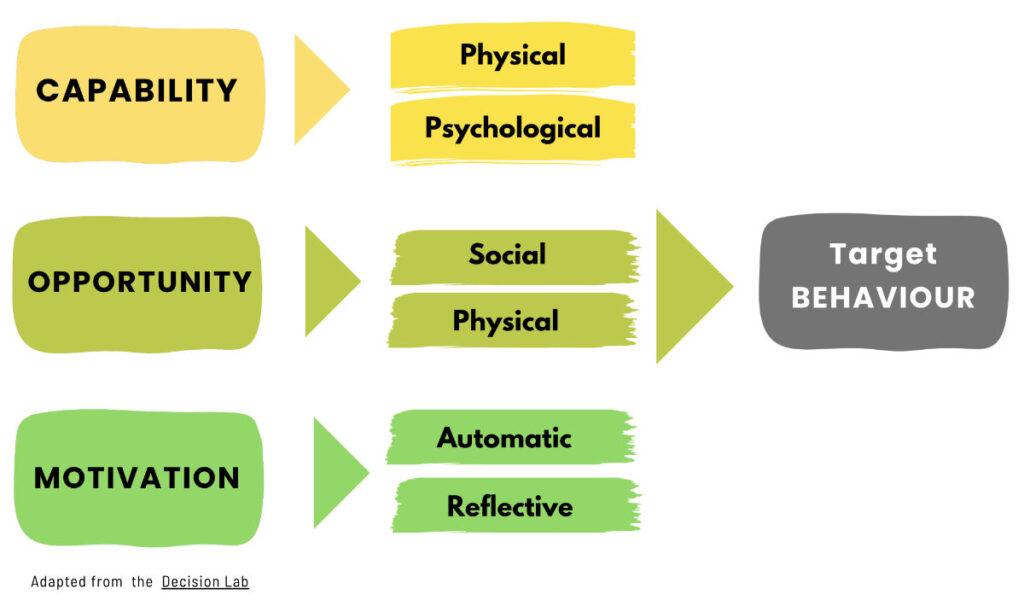
Assessing the capability (C), opportunity (O) and motivation (M) of coaches helps the coach developer (CD) to understand why specific coach behaviours occur. Armed with these insights the CD using the framework can intervene to change behaviour. More information can be found here.
Below I’ll explore what these three domains could look like within a coach development context, as well as based on my own experience what is the most frequently overlooked domain by coach developers.
Capability
Capability is often the domain where coach developers naturally anchor their work, as their primary intent is typically to develop coaches’ knowledge and skills. Within the COM‑B framework, capability is divided into psychological capability, which includes knowledge, understanding, and skills, and physical capability.
Coach developers are most effective when they strike the right balance between:
- Introducing new knowledge or concepts
- Developing or refining practical coaching skills/approaches
- Allowing opportunities to apply that learning in semi-realistic contexts
When these elements are aligned, coaches are more likely to embed new behaviours.
A critical, but sometimes overlooked, step is gathering prior knowledge about coaches before a learning opportunity is delivered. Understanding where coaches’ current capability sits allows coach developers to meet coaches where they are, rather than pitching content above or below their existing level. This relatively simple step can significantly enhance the effectiveness of learning but is often ignored due to time or logistical constraints.
Opportunity
Opportunity is another domain that coach developers typically address in some capacity. In the COM‑B model, opportunity refers to external factors that enable or constrain behaviour change. This includes both physical opportunity (environmental conditions and resources) and social opportunity (interpersonal and cultural influences).
Coach developers commonly address opportunity by providing coaches with access to learning environments, such as workshops or courses, as well as opportunities to practice new behaviours through micro‑coaching activities. While this is valuable, other influences within this domain are frequently missed and can act as “handbrakes” to change.
One major factor is the environment coaches return to after the learning opportunity. Limited resources, sub‑optimal facilities, or the perceived capability of athletes can all lead coaches to abandon newly learned practices. To mitigate this, coach developers can regularly ask coaches questions such as:
“How could you adapt and apply this within your own environment? And what could the barriers be?”
This encourages problem‑solving during the learning experience rather than after it.
Social opportunity is another powerful constraint. Coaches may be introduced to new theories or approaches but find that prevailing social norms within their club or school discourage adoption. These norms may be shaped by program leaders, fellow coaches, or even the athletes themselves, making it difficult for coaches to apply what they have learned.
Coach developers can help here. Here are some examples:
- Challenge coaches with constraints-based scenarios (team members absent, mixed ability, weather constraints)
- Plan up front for possible barriers – have a plan B
- Engage club stakeholders (other coaches, parents, committee)
Motivation
In my experience, motivation is the domain most commonly overlooked by coach developers. The COM‑B framework distinguishes between reflective motivation (conscious planning, intention, and evaluation) and automatic motivation (habits, impulses, and emotional responses).
A key question that coach developers should ask, either before coaches arrive or very early in the learning process, is:
“Why do you coach?”
When learning is explicitly connected back to a coach’s personal motivation, it becomes more meaningful and more likely to transfer into practice.
For example, if a coach is motivated by a desire to help players enjoy sport and reach their potential, a coach developer can intentionally link new activities or approaches to that underlying motivation. This strengthens reflective motivation by helping coaches see how the learning supports their “why.”
Automatic motivation is often more difficult to influence. A coach’s identity, background, and past experiences shape deeply ingrained habits and responses. As a result, one‑off learning opportunities are rarely sufficient to create lasting change. Instead, a blended, multi‑touch coach development approach is more effective. This might include:
- Formal learning (workshops, courses, online modules)
- Social learning (communities of practice)
- On‑the‑job learning (observation, feedback, and mentoring)
Together, these approaches increase the likelihood of sustained behaviour change.
Conclusion
Coach developers who take a deliberate and balanced approach across Capability, Opportunity, and Motivation significantly increase the probability of achieving lasting behaviour change.
By consciously designing coach development approaches that address all three domains, coach developers can better support coaches in translating learning into meaningful action within their own coaching environments.
Dig deeper
An introductory 15-minute video on the COM-B model can be found here.
 By Gene Schembri